
French Vet Vocabulary and Useful Phrases for PET Owners in France
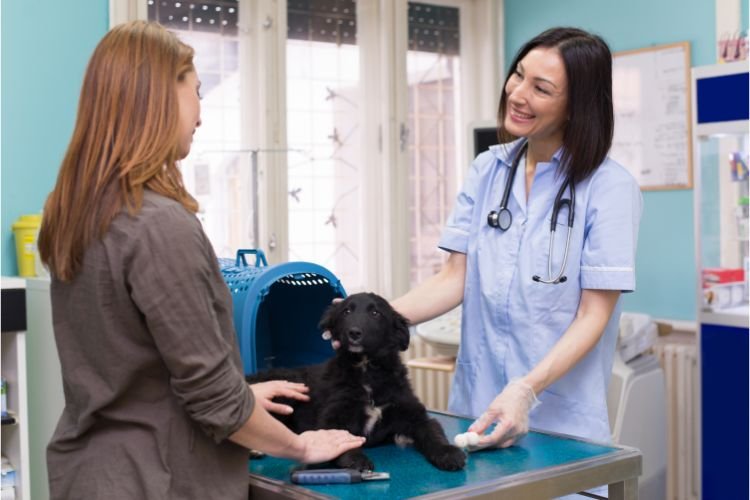
One of the more intimidating parts of taking your pet to the vet in France is not always the appointment itself. Sometimes it is simply not knowing the right words.
Even if your vet speaks some English, it helps a lot to recognize basic terms, explain why you are there, and understand the kinds of questions you may be asked. That is especially true for first appointments, vaccines, parasite prevention, prescriptions, and any visit that is a little more stressful than a routine checkup.
If you’re still sorting out the practical side of bringing a pet to France, I also wrote a guide to the first vet visit, the I-CAD registration deadline, and obtaining the pet passport. That post walks through the paperwork and early steps, while this one focuses on the French words and phrases that are useful at the vet.
Basic French Vet Vocabulary
Here are some of the most useful words to know.
- un vétérinaire / le véto = veterinarian / vet
- une clinique vétérinaire = veterinary clinic
- un rendez-vous = appointment
- prendre rendez-vous = to make an appointment
- un chien = dog
- une chienne = female dog
- un chiot = puppy
- un chat = cat
- une chatte = female cat
- un chaton = kitten
- un animal de compagnie = pet
Identification and Paperwork Vocabulary
These are especially useful if you have recently moved to France with your pet.
- la puce électronique = microchip
- l’identification = identification
- faire identifier son animal = to have a pet identified
- le numéro de puce = microchip number
- le passeport pour animal de compagnie = pet passport
- le passeport européen pour animal de compagnie = EU pet passport
- le carnet de santé = health record booklet
- l’enregistrement I-CAD = I-CAD registration
- un certificat sanitaire = health certificate
- la rage = rabies
- la vaccination antirabique = rabies vaccination
Vaccine and Preventive Care Vocabulary
A lot of routine vet conversation revolves around vaccines and parasite prevention.
- un vaccin = vaccine
- la vaccination = vaccination
- un rappel = booster shot
- être à jour de ses vaccins = to be up to date on vaccines
- un antiparasitaire = parasite preventive
- un vermifuge = dewormer
- un traitement contre les puces = flea treatment
- un traitement contre les tiques = tick treatment
- les puces = fleas
- les tiques = ticks
- les moustiques = mosquitoes
- les phlébotomes = sand flies
- la leishmaniose = leishmaniosis
General Medical Vocabulary
These are useful for more routine care and minor health issues.
- une ordonnance = prescription
- un médicament = medication
- une prise de sang = blood test / blood draw
- une analyse = test / lab analysis
- une radiographie = X-ray
- une échographie = ultrasound
- un détartrage = dental cleaning / scaling
- une opération = operation / surgery
- une anesthésie = anesthesia
- stérilisé(e) = spayed / neutered
- la stérilisation = spaying / neutering
- castrer = to neuter a male
- stériliser = to spay / sterilize
Symptoms and Problems
You do not need perfect French to describe a problem, but a few keywords help a lot.
- il/elle ne mange pas = he/she is not eating
- il/elle vomit = he/she is vomiting
- il/elle a la diarrhée = he/she has diarrhea
- il/elle boîte = he/she is limping
- il/elle se gratte = he/she is scratching
- il/elle a mal = he/she is in pain
- une blessure = an injury
- une patte = paw / leg
- une oreille = ear
- les dents = teeth
- la peau = skin
- les yeux = eyes
Useful French Phrases for the Vet
These are the kinds of phrases that can be helpful for making or attending appointments.
How to Make an Appointment
- Bonjour, je voudrais prendre rendez-vous pour mon chien.
Hello, I’d like to make an appointment for my dog. - Je voudrais prendre rendez-vous pour mon chat.
I’d like to make an appointment for my cat. - Avez-vous un rendez-vous disponible aujourd’hui ?
Do you have an appointment available today? - Ce n’est pas urgent, mais j’aimerais le/la faire examiner.
It is not urgent, but I’d like to have him/her examined.
If You Have Just Moved to France
- Je viens d’arriver en France avec mon chien/chat.
I’ve just arrived in France with my dog/cat. - Je voudrais faire son enregistrement I-CAD.
I’d like to do his I-CAD registration. - Je voudrais faire établir un passeport pour mon animal.
I’d like to have a passport issued for my pet. - Est-ce qu’on peut faire le passeport pendant ce rendez-vous ?
Can we do the passport during this appointment? - Voici son carnet de santé / son passeport / ses papiers.
Here is his/her health booklet / passport / paperwork.
For Yearly Exams and Vaccines
- Je voudrais prendre rendez-vous pour son examen annuel.
I’d like to make an appointment for his/her annual exam. - Je voudrais prendre rendez-vous pour ses vaccins.
I’d like to make an appointment for his/her vaccines. - Est-ce qu’il est à jour de ses vaccins ?
Is he up to date on his vaccines? - Quels vaccins recommandez-vous dans cette région ?
Which vaccines do you recommend in this area? - Est-ce que vous recommandez le vaccin contre la leishmaniose ?
Do you recommend the leishmaniosis vaccine?
For Flea, Tick, and Parasite Prevention
- Je voudrais un traitement contre les puces et les tiques.
I’d like a flea and tick treatment. - Qu’est-ce que vous recommandez ici contre les tiques ?
What do you recommend here for ticks? - Qu’est-ce que vous recommandez ici contre les moustiques ou les phlébotomes ?
What do you recommend here for mosquitoes or sand flies? - Quel antiparasitaire utilisez-vous le plus souvent pour les chiens et les chats ici ?
Which parasite preventive do you use most often here for dogs and cats? - Est-ce qu’il lui faut une ordonnance ?
Does it require a prescription?
If Your Pet Is Sick
- Mon chien / chat ne mange pas.
My dog / cat is not eating. - Mon chien / chat vomit.
My dog / cat is vomiting. - Mon chien / chat a la diarrhée.
My dog / cat has diarrhea. - Mon chien / chat boîte.
My dog / cat is limping. - Mon chien / chat se gratte beaucoup.
My dog / cat is scratching a lot. - Je pense qu’il / elle a mal.
I think he / she is in pain. - Il / elle a une blessure à la patte.
He / she has an injury to his / her paw. - Depuis combien de temps ?
For how long?
This is a question you may hear from the vet. - Depuis hier / ce matin / depuis deux jours.
Since yesterday / since this morning / for two days.
Useful Questions You May Hear at the Vet
These are worth recognizing because they come up often.
- Quel âge a-t-il / a-t-elle ?
How old is he / she? - Il / elle pèse combien ?
How much does he / she weigh? - Il / elle mange normalement ?
Is he / she eating normally? - Il / elle boit normalement ?
Is he / she drinking normally? - Il / elle a vomi ?
Has he / she vomited? - Il / elle a de la diarrhée ?
Does he / she have diarrhea? - Il / elle est vacciné(e) ?
Is he / she vaccinated? - Il / elle est identifié(e) ?
Is he / she microchipped / identified? - Il / elle prend un traitement ?
Is he / she taking any medication?
Useful Answers You Can Give
- Oui / non = yes / no
- Je ne sais pas = I do not know
- Un peu = a little
- Beaucoup = a lot
- Depuis hier = since yesterday
- Depuis quelques jours = for a few days
- Oui, il/elle prend déjà un traitement.
Yes, he/she is already taking medication. - Non, pas à ma connaissance.
No, not to my knowledge.
A Few Practical Tips if Your French Is Limited
You do not need perfect French to handle a vet appointment. A few things help a lot:
Bring all your paperwork, including the pet passport, vaccine history, and any medication list.
Write down the main issue in advance in simple French or even in a translation app.
Learn a few keywords rather than trying to memorize long sentences. Often words like vomit, limping, tick, passport, microchip, and prescription are enough to get the point across.
And if you are nervous, it is completely fine to say:
- Désolé(e), mon français n’est pas encore très bon.
Sorry, my French is not very good yet. - Est-ce que vous parlez un peu anglais ?
Do you speak a little English?
TIP
It is worth keeping a translation app on your phone that works offline, such as Google Translate. Be sure to download both your own language and the language you will need before the appointment, since you may not always have a signal or Wi-Fi. In some apps, that offline download has to be done manually in the settings.
A Few Words Before You Go
Taking your pet to the veterinarian in another language can feel intimidating at first, but it gets easier surprisingly quickly. Most appointments rely on the same small group of words and phrases, and once you know the basics, you can usually get through the important parts without too much trouble.
The biggest help is simply knowing a few key words and phrases ahead of time, so the whole visit feels a little less stressful when the moment comes.