Roman Ruins in Nîmes: A Guide to France’s Best-Preserved Roman City
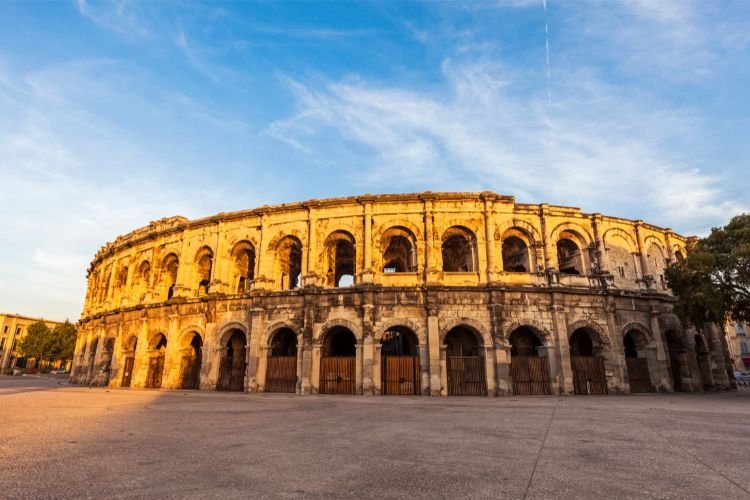
You don’t really find Roman ruins in Nîmes. You live among them.
You walk past an ancient arena on your way to lunch. You sit in a café facing a 2,000-year-old temple. You climb a garden path and realize you’re standing on Roman fortifications.
Nîmes isn’t an archaeological site you visit for an hour. It’s a real, working French city that happens to be built around some of the best-preserved Roman monuments in the world. If you’re traveling through southern France and love history — or simply appreciate beautiful architecture — this is one place you shouldn’t skip.
The Arena of Nîmes (Les Arènes)
The Arena of Nîmes is one of the best-preserved Roman amphitheaters in existence. Built around 70 AD, it once held roughly 20,000 to 24,000 spectators for gladiator games and public spectacles. Unlike many ancient arenas, it remains structurally intact, which makes it easy to understand how it functioned.
Visitors can walk through the corridors, climb the seating tiers, and stand on the arena floor itself. The scale becomes immediately clear. The oval form, the rhythm of the arches, and the efficiency of the passageways reflect the Roman talent for crowd management and durable design. The arena is still used today for concerts and cultural events, reinforcing how seamlessly it remains part of the city.

The Maison Carrée: A Temple in Remarkable Condition
In the center of Nîmes stands one of the most complete Roman temples in the world. The Maison Carrée dates to around 16 BC and was dedicated to the grandsons of Emperor Augustus. Its proportions are balanced and deliberate, with tall Corinthian columns and a deep portico that still feels strikingly modern.
Because it has survived so intact, it offers a rare opportunity to see Roman temple architecture as it was originally intended. The building later influenced neoclassical structures across Europe and the United States. Standing in front of it, it’s easy to recognize how Roman design principles have shaped Western architecture for centuries.
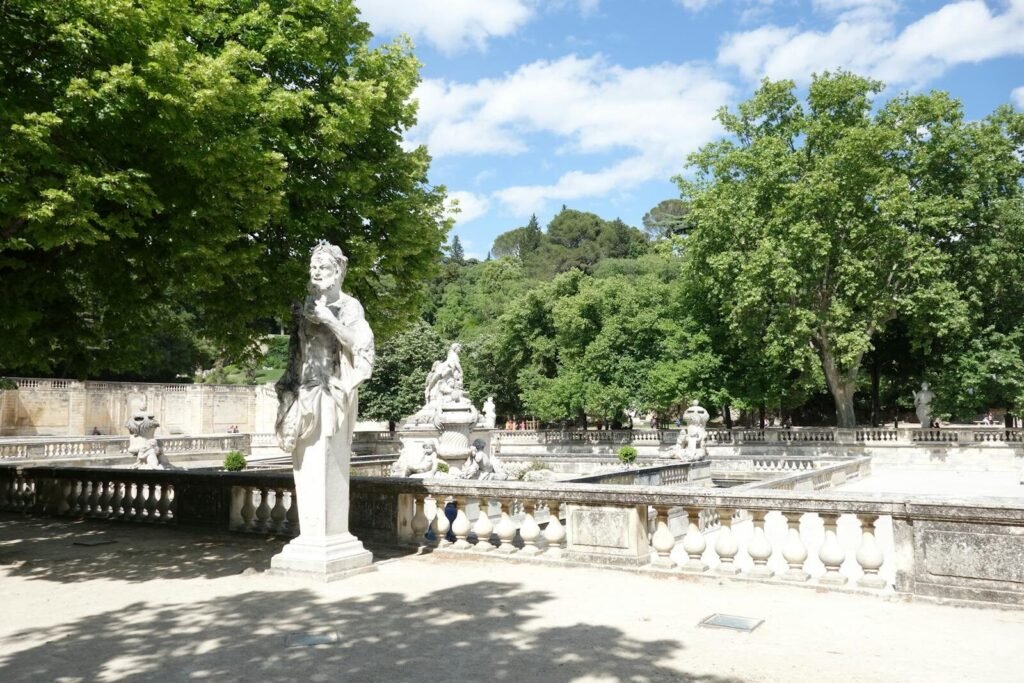
Jardins de la Fontaine, the Temple of Diana & the Tour Magne
The Jardins de la Fontaine form one of the most pleasant areas of the city and contain some of its oldest Roman remains. Within the gardens you’ll find the so-called Temple of Diana, likely part of a larger Roman complex that may have included a library or meeting space. Though partially ruined, the vaulted interior and stonework remain impressive and atmospheric.
At the top of the gardens stands the Tour Magne, the last remaining tower of the city’s Roman fortifications. Climbing it provides a clear view of how the ancient city was laid out and how much of that structure still shapes modern Nîmes. From above, the arena is easily visible, reinforcing how compact and interconnected these sites are.
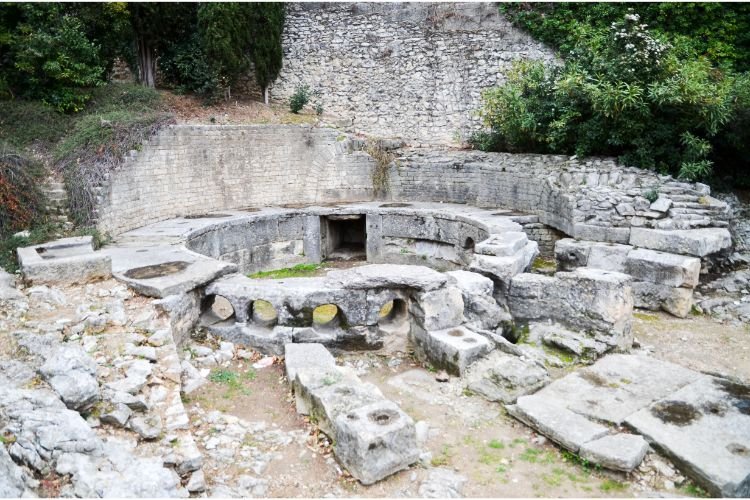
Castellum Divisorium
The Castellum Divisorium isn’t as visually dramatic as the arena or the Maison Carrée, but it may be one of the most significant Roman sites in Nîmes.
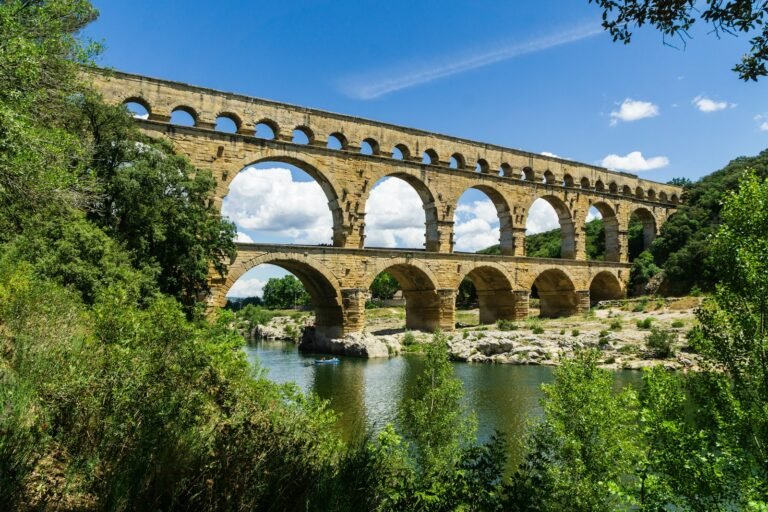
This circular stone basin is where the water from the Pont du Gard aqueduct finally entered the city. After traveling nearly 50 kilometers through the aqueduct system, the water flowed into this tank and was redirected through a series of carved openings around the interior wall. Each opening led to a different pipe supplying a different part of the city.
The Romans engineered the system with supply management in mind. The outlets were set at slightly different heights. When water levels were high, all of them flowed. If levels dropped, the higher openings stopped first while the lower ones continued to receive water. This created a built-in hierarchy.
Essential public services — fountains and major baths — could continue operating even during reduced supply. Secondary uses, such as some private homes or less critical services, would lose water first. Rather than relying on constant oversight, the design itself regulated distribution. The Castellum formed part of a carefully planned urban water network built to keep the city functioning.
Other Roman Sites Worth Noting
Nîmes contains more Roman remains than you can realistically explore in a single afternoon. Beyond the major monuments, a few additional sites help round out the picture of how extensive the ancient city once was.
The Musée de la Romanité sits directly across from the arena and provides valuable context for everything you see outdoors. The museum houses mosaics, statues, inscriptions, and everyday objects uncovered in and around Nîmes. While it isn’t a Roman structure itself, it deepens your understanding of how the city functioned — from domestic life to religion to infrastructure.
Along the former line of the city walls, portions of the ancient fortifications are still visible, including the Porte d’Auguste. This surviving Roman gate once formed part of the main entrance into the city and makes it easier to imagine the scale of Nîmes at its height. Nearby wall sections reinforce how fortified and strategically planned the city was.
Within the Jardins de la Fontaine lies the original sacred spring that drew settlers to this location long before it became a Roman colony. The Romans monumentalized the site, building terraces and structures around the water source. Nîmes grew around water, and Roman engineering expanded what was already there.
How Much Time Do You Need in Nîmes?
Most visitors can see the major Roman sites in half a day, but a full day allows time to explore without rushing. The arena alone can take an hour or more if you walk through it thoroughly. Adding the Maison Carrée, the gardens, the tower, and the Castellum creates a well-paced itinerary that connects architecture with infrastructure.
Nîmes is compact and easy to explore on foot, which makes it simple to combine with other major Roman sites in the region. Pont du Gard lies about 25 kilometers from Nîmes — roughly a 30-minute drive — and pairs easily with a morning or afternoon in the city. Seeing the aqueduct bridge and then visiting the Castellum in Nîmes helps connect the engineering to the urban system it once supported.
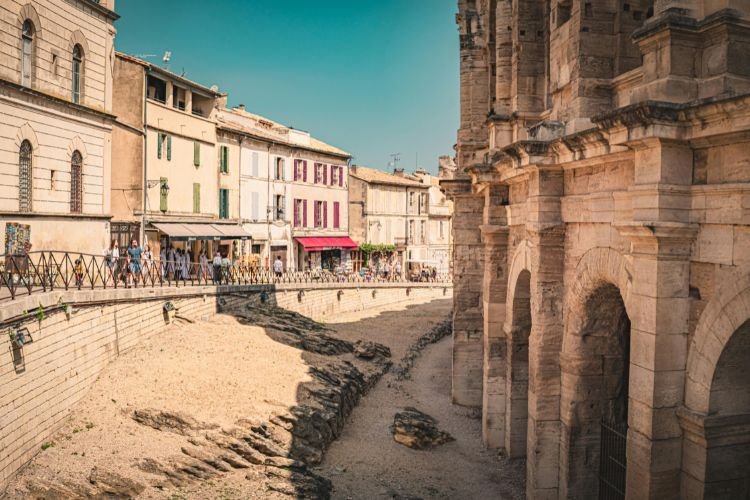
Just west of Nîmes, Arles offers another concentration of remarkable Roman monuments, including its amphitheatre, theatre, baths, and underground Cryptoportiques. Adding Arles to your itinerary deepens the experience, allowing you to see how Roman urban design evolved across multiple cities in southern Gaul.
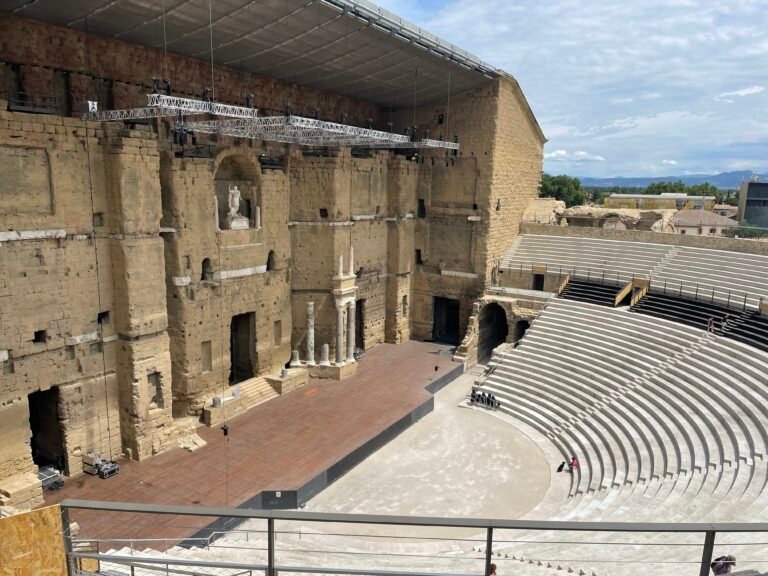
If you continue east, the Théâtre antique d’Orange is about 40 minutes beyond Pont du Gard. Together, these four major sites — Nîmes, Arles, Pont du Gard, and Orange — form a natural Roman itinerary through southern France, each highlighting a different aspect of Roman life: infrastructure, urban planning, and entertainment.
Planning a Roman Road Trip in Southern France?
This guide is part of my complete resource on the best Roman ruins in Southern France, including Nîmes, Arles, Orange, Pont du Gard, and hidden gems across Provence and Occitanie.