Roman Theatre of Orange, France: One of the Best-Preserved Roman Theatres in the World
Some historic sites are impressive because they’re ancient. The Roman Theatre of Orange is impressive because it’s ancient and astonishingly intact.
This is widely considered one of the best-preserved Roman theatres in the world, and when you step inside, that reputation makes immediate sense. Unlike many Roman sites that survive only as partial ruins, this theatre still reads clearly as a theatre. You don’t have to imagine much—the structure does the work for you.
I visited with my sons, and it was one of those rare places where history felt tangible. You’re not just looking at the past here—you’re standing inside it.
Built in the 1st Century — and Still Standing
The theatre was constructed in the early 1st century AD, during the reign of Emperor Augustus, when Orange was an important Roman colony. It could seat around 9,000 spectators and was designed as both an entertainment venue and a political statement.
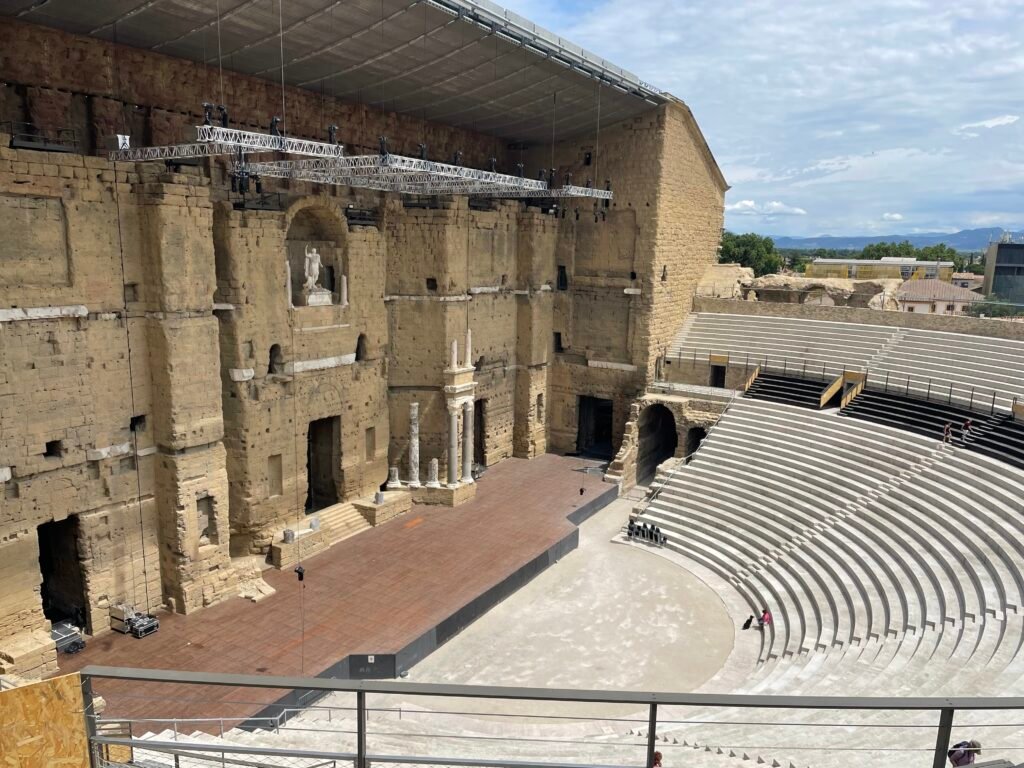
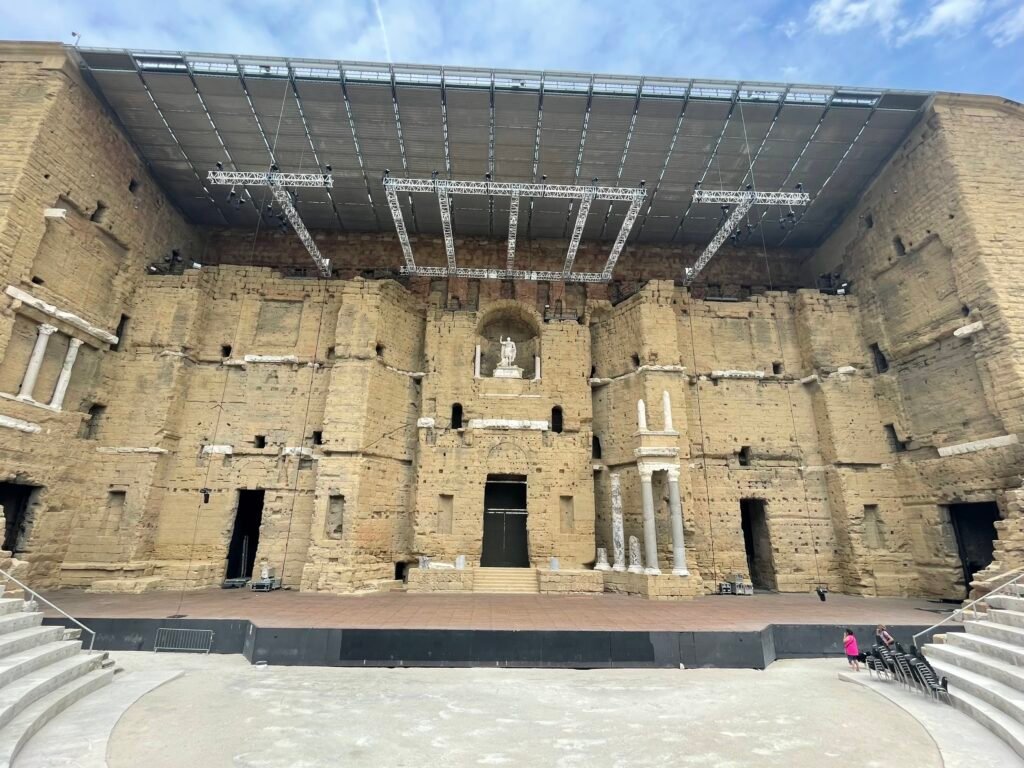
What makes it extraordinary is the survival of its monumental stage wall. In most Roman theatres, this back wall disappeared centuries ago. In Orange, it still rises dramatically behind the stage, nearly to its original height. It forms a massive stone backdrop that once would have been decorated with columns, sculptures, and ornamentation.
In the central niche stands a statue of Augustus (a later installation, but fitting), reinforcing how closely theatre, politics, and public life were intertwined in Roman times.
Engineering Details That Still Impress
The Romans didn’t just build big—they built smart.
The seating was carved into the natural hillside, creating both stability and impressive acoustics. Even today, voices carry clearly from the stage into the upper tiers. The theatre still hosts performances, including the famous summer opera festival, the Chorégies d’Orange, proof that the original design still works.
The theatre also originally used a velum system—a retractable fabric awning that could be extended to shade spectators. While the fabric itself is long gone, Roman theatres were equipped with rope-and-pole systems to provide sun protection. It’s fascinating to picture thousands of spectators sitting beneath what was essentially an ancient stadium canopy.
Today, a modern roof covers the stage area during performances—another example of how this monument continues adapting while preserving its past.
A Theatre With Many Lives
After the Roman period, the theatre wasn’t simply abandoned. It was reused, fortified, and gradually built into the surrounding town. For centuries, it served defensive and residential purposes. Ironically, those later uses helped preserve it rather than destroy it.
In the 19th century, restoration efforts revealed how much of the original structure remained. What we see today is the result of careful preservation of something that was never completely lost.
That layered history adds to its uniqueness. This isn’t a ruin rediscovered in a field—it’s a monument that has evolved with the city around it.
The Audio Tour: Where It All Clicks
We chose the audio tour, and it made the experience far richer. It’s organized around numbered stops throughout the theatre, allowing you to move at your own pace.
At certain points, the guide encourages you to stand in specific seating sections while listening. From there, it explains how Roman society was literally reflected in the layout.
Elite citizens and officials sat closest to the stage. Ordinary citizens were seated higher up—in what we’d now call the nosebleed sections. Standing in those upper tiers, looking down at the stage, the social hierarchy suddenly feels very real—and very familiar.
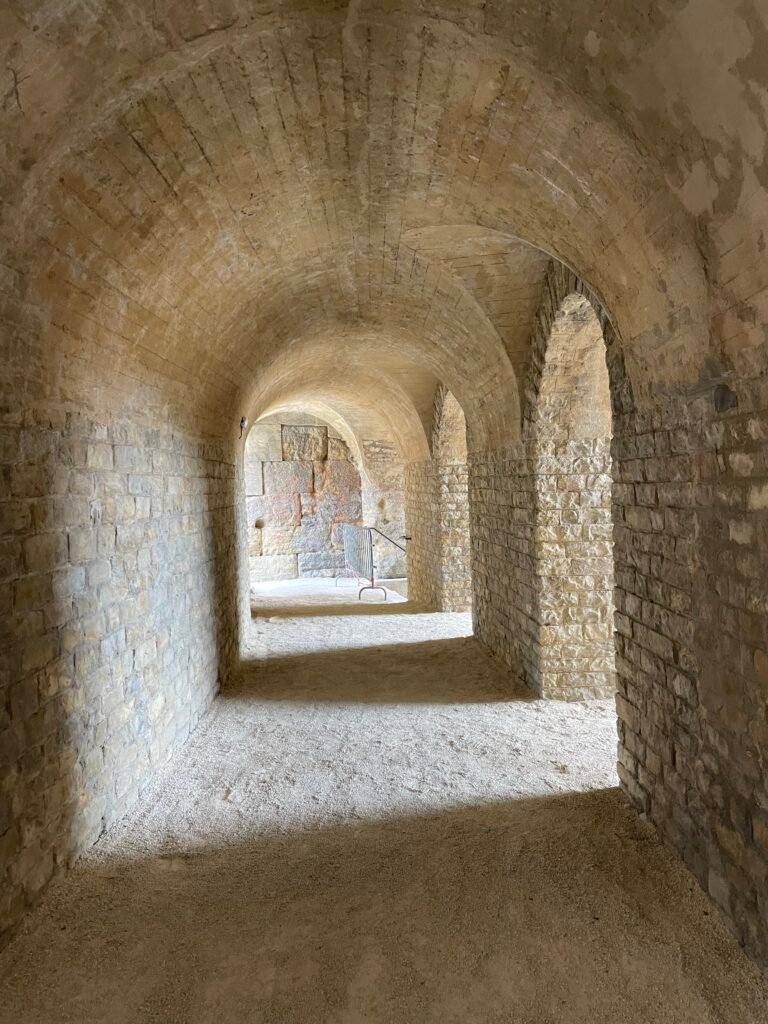
Behind the Seating: A Surprisingly Familiar Space
Behind and beneath the seating are vaulted corridors and small rooms that you can explore during your visit.
While these corridors were essential for circulation and crowd movement, archaeologists believe that some of the smaller rooms opening off these passageways may also have been used for refreshments, games, or socializing during performances—not unlike the concourses of modern stadiums.
Walking through them, that comparison feels surprisingly natural. The ancient world doesn’t feel so distant in those spaces.
The Museum and Other Roman Sites in Orange
Across from the theatre, the small museum displays recovered tiles, fragments, and objects that help you imagine the theatre as it once was—decorated, colorful, and lively.
If you’re exploring Roman history in Orange, it’s also worth visiting the nearby Triumphal Arch of Orange, another impressive Roman monument that’s easy to combine into the same outing.
The Perfect Pairing With Pont du Gard
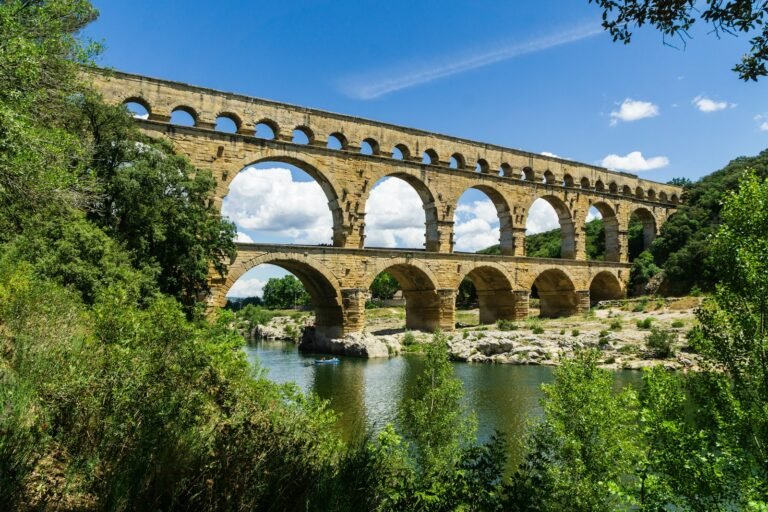
If you’re planning a Roman-themed itinerary through southern France, the Pont du Gard and the Roman Theatre of Orange complement each other beautifully. Located just about 40 minutes apart by car, they make an easy and rewarding combination.
The Pont du Gard showcases Roman engineering and infrastructure on a monumental scale. The theatre reveals Roman culture, entertainment, and daily life. Together, they present two sides of the same civilization—one focused on innovation and utility, the other on spectacle and shared experience.
Why It Stays With You
What makes the Roman Theatre of Orange special isn’t just its age. It’s the preservation. The scale. The fact that it still functions as a theatre nearly two millennia after it was built.
It doesn’t feel like a ruin—it feels relevant.
Standing there, you understand how the architecture worked, how society was organized within it, and how thousands once gathered in that exact space. And then you realize they still do. Performances continue beneath the same monumental wall, audiences still fill the tiers, and the theatre still does what it was designed to do. The Roman Theatre of Orange doesn’t just show you the past. It lets you experience how surprisingly close it still feels.
If you’re interested in exploring more Roman history in the region, don’t miss my guides to these two cities:
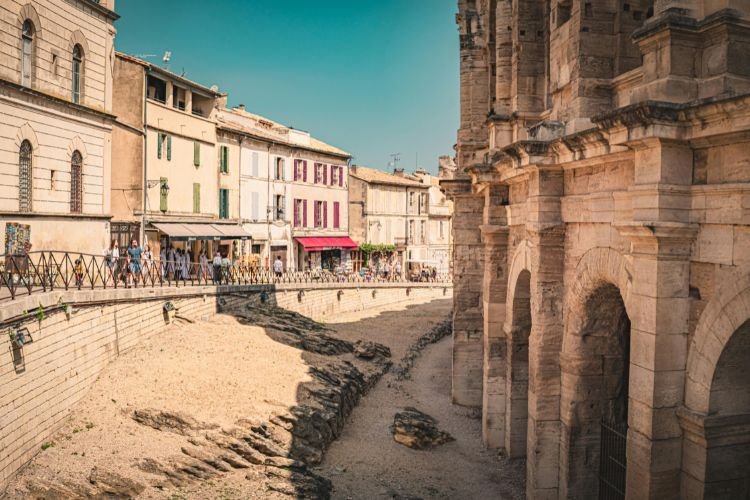
Roman Nîmes — home to a remarkably preserved arena, the Maison Carrée, and the Castellum where water from Pont du Gard entered the city.
Roman Arles — known for its impressive amphitheatre, ancient theatre, Baths of Constantine, and the atmospheric Cryptoportiques beneath the former Roman forum.
Planning a Roman Road Trip in Southern France?
This guide is part of my complete resource on the best Roman ruins in Southern France, including Nîmes, Arles, Orange, Pont du Gard, and hidden gems across Provence and Occitanie.