Paying Tolls in France: What Tourists and Newcomers Need to Know Before Driving
France has one of Europe’s most extensive motorway systems, and much of it is toll-based. If you’re visiting or newly living in France, toll booths (péages) can feel intimidating at first: fast-moving lanes, unfamiliar symbols, and the pressure to pay quickly while cars queue behind you.
The good news? Once you understand how the system works—and which lane to choose—paying tolls in France is straightforward. A little preparation goes a long way, both for your own peace of mind and for the drivers around you.
Where You’ll Encounter Tolls in France
Tolls are primarily found on autoroutes (the major highways marked with an “A”), especially on long-distance routes connecting cities and regions.
You’re most likely to encounter tolls when driving:
- Between major cities (Paris/Lyon, Paris/Bordeaux)
- Toward popular tourist areas (the South of France, Normandy, the Alps)
- On long road trips rather than short local drives
Most toll roads use a ticket system: you take a ticket when entering the autoroute and pay when exiting, based on distance traveled. Others have a single payment point where you pay once as you pass through.
The 3 toll systems you’ll encounter in France
Ticket system (péage fermé) — very common
This is the system most tourists notice.
- You take a ticket when entering the autoroute
- You pay when exiting, based on distance traveled
- Common on long routes between cities and regions
What to know
- Don’t lose the ticket—you’ll need it to pay
- If you do lose it, you’re usually charged the maximum fare for that stretch
- With a toll transponder, the ticket is handled automatically
Open toll system (péage ouvert) — also common
No ticket here.
- You pay once as you pass a toll plaza
- No entry ticket, no exit ticket
- More common on:
- Shorter motorway sections
- Certain bridges, tunnels, or regional routes
What to know
- You pay immediately (card, cash, or transponder)
- These booths often appear suddenly—watch signage
Free-flow tolling (péage en flux libre) — new and expanding
This is the newest system and the most confusing for visitors.
- No booths, no barriers, no ticket
- Overhead gantries scan your plate or transponder
- You must:
- Have a toll transponder OR
- Pay online within a set time (usually 72 hours)
Where you’ll see it
- On select modernized motorways (not yet everywhere)
- Clearly signed—but easy to miss if you’re unfamiliar
Understanding Toll Booth Lane Symbols: Which One Should You Use
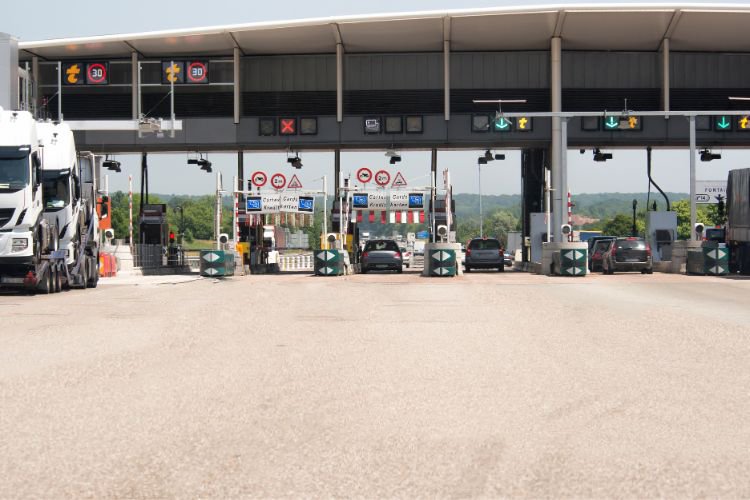
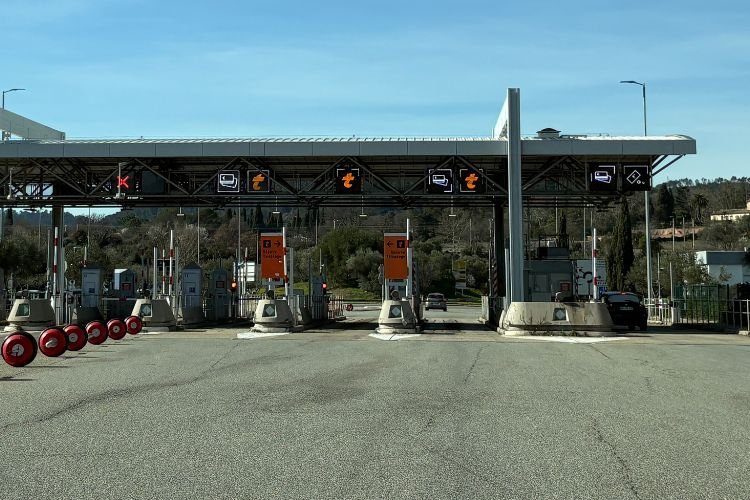
When you approach a toll plaza (péage) in France, you’ll see symbols above each lane showing what payment methods are accepted and how you should drive through. Knowing what they mean ahead of time makes the whole process smoother and less stressful.
Lane Symbols Explained
Here are the main lane indicators you’ll see:
- Green arrow: Lane is open and accepts all payment methods: cash, card, or electronic toll badge (télépéage).
- “CB” (white/card icon): Lane accepts credit or debit card only. Cards are usually faster than cash lanes.
- Coins (cash icon): Lane where you pay with cash only (coins and bills accepted at the machine).
- Orange “T”: Indicates a télépéage lane where vehicles equipped with an electronic toll badge can pass through. In many plazas, this “T” appears together with other symbols (e.g., a green arrow), meaning that while the lane accepts badge users, it also takes other payments — but badge users can go through with minimal stopping.
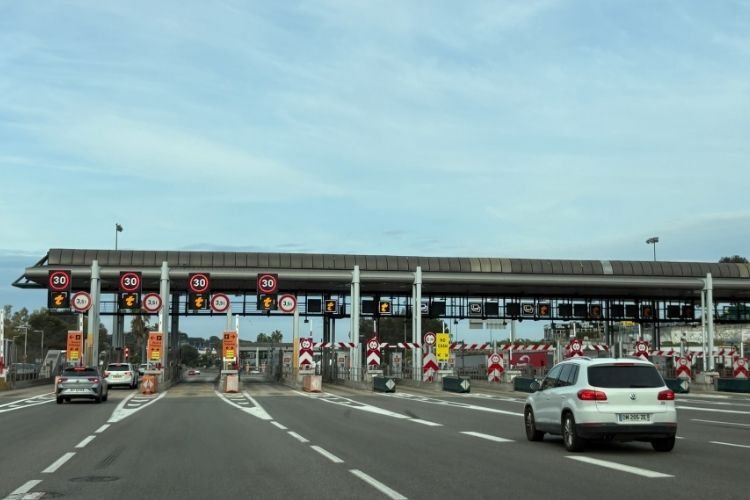
- “T” and a speed limit sign: Some toll booths also have dedicated slow-speed toll badge lanes marked with “T” and a speed limit sign (e.g., 30 km/h) where you do not stop, but must slow down for the sensor and barrier to detect your badge.
- Red X: Lane is closed and should not be entered.
Quick Tips for Choosing the Right Lane
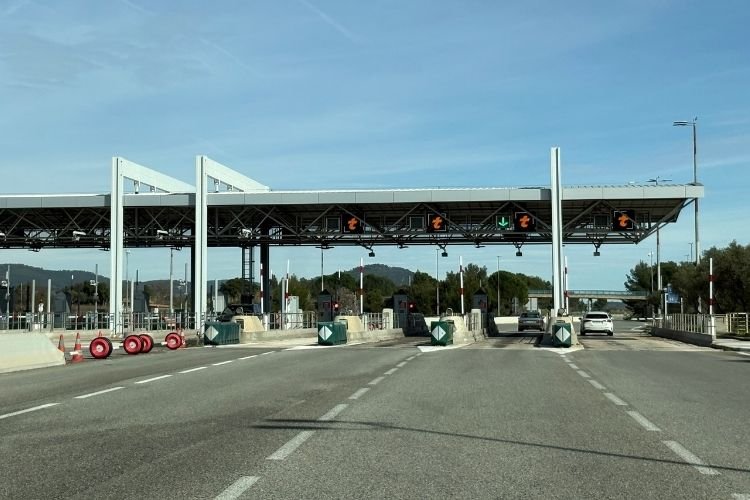
If you have a toll badge, look for the orange “T” and especially lanes marked with a speed (e.g., 30 km/h) — these let you pass through with minimal slowing.
If you don’t have a badge, choose a green arrow lane or lanes marked for cash/card.
Avoid entering a lane with only a bold “T” if you don’t have a badge — that lane may not open for you.
Signs are typically lit and visible well before the toll booths, so begin choosing early.
As you approach a toll plaza, lanes often split quickly. Drivers behind you may already know which lane they need, which can add pressure if you’re still scanning signs. The key is to start looking early and commit calmly.
How to Pay at French Toll Booths
Paying with a Card
- Visa and Mastercard are widely accepted
- Some lanes are card-only
- Contactless is common, but not universal—be prepared to insert your card
Paying with Cash
- Still accepted, but not in every lane
- Having coins or small bills ready helps keep traffic flowing
Using a Toll Transponder (Télépéage)
A toll transponder is a small device mounted on your windshield that automatically pays tolls as you pass through dedicated lanes. You don’t stop, insert a card, or handle cash—the barrier opens automatically and charges are billed to your account.
The Cultural Side of Toll Roads in France
Efficiency matters on French autoroutes. Local drivers expect toll stops to be quick and predictable, especially during busy travel periods.
An unprepared driver searching for a wallet, choosing the wrong lane, or blocking a booth can delay dozens of cars behind them. This isn’t about impatience—it’s about safety and traffic flow. Knowing how tolls work helps you blend in and drive with confidence.
Toll Transponder Providers for Individuals
Several providers offer toll transponders. All will work on all French autoroutes.
Ulys
- Multiple personal plans with no long-term commitment
- Monthly fee is usually charged only in months you use it
- Some plans include Spain, Portugal, and Italy
Bip&Go
- Flexible plans for occasional or frequent drivers
- Strong international coverage options
- Widely used for cross-border travel
Fulli
- Simple, straightforward plans
- Often chosen by regional or seasonal drivers
- International options available depending on plan
How to Get a Toll Transponder
Most people order their toll transponder online directly from the provider’s website and have it mailed to their home address in France.
In some cases, limited in-person pickup may be available at:
- Select motorway service areas
- Certain autoroute customer service offices
Availability varies, and it’s not guaranteed. Toll booths themselves do not sell transponders.
Rental car companies sometimes offer a télépéage option, usually charged per day—convenient for short trips, but more expensive than having your own badge.
Using Your Toll Transponder in Other Countries
Many French toll transponders can also be used in Spain, Portugal, and Italy, depending on the plan. If you’re planning a cross-border road trip, be sure to choose a badge with international coverage.
Final Tips for Stress-Free Toll Driving in France
- Watch lane symbols early
- Have your payment method ready before reaching the booth
- Avoid télépéage-only lanes unless you have a badge
- Consider a toll transponder if you’ll drive on autoroutes more than occasionally
Are you worried about understanding French words on road signs? See my post on deciphering French road related terms.