The Magic of the French Croissant
I confess, I never really thought I cared much for croissants before moving to France. Back home, I’d choose a cinnamon roll, a crème-filled éclair, or a glazed donut every time over those tasteless, boring curved bread rolls. Even on my first few trips to France, I passed them by, snubbing the iconic croissant in favor of all the other tempting viennoiseries and pastries waiting behind the glass.
Then, on one longer stay, I finally tried a real French croissant, and I was floored.
This was not the soft, flavorless bread I’d dismissed for years. It was a flaky, buttery, airy, golden parcel of perfection. Not too sweet, not too heavy — it was absolutely made to enjoy with a morning coffee.
The Surprising Origins of the Croissant
Despite its very French reputation, the croissant didn’t start out French at all.
Its ancestor is the kipferl, a crescent-shaped pastry from Austria that’s been around for centuries. In the 1800s, an Austrian baker named August Zang opened a Viennese-style bakery in Paris. The shape caught on — but French bakers did what they do best: they refined it.
They swapped bread dough for laminated dough layered with butter, creating something lighter, flakier, and far more delicate. Over time, that pastry became less of a novelty and more of a habit — and eventually, a symbol.
What Does “Croissant” Actually Mean?
The word croissant comes from the French verb croître, meaning “to grow,” but it also refers to the crescent shape itself — like a waxing moon (croissant de lune).
And yes, pronunciation matters. In France, it’s krwah-sahn, with a soft nasal ending. If you say “kwa-sont,” you’ll still get your pastry… but you’ll give yourself away as a tourist while doing it.
What Makes a Croissant a Croissant?
One of the most surprising things about croissants is how few ingredients they use. There’s nothing fancy or secret about the list — it’s all about technique.
A traditional croissant is made with:
- Flour
- Butter (good butter — this matters)
- Yeast
- Sugar
- Salt
- Milk or water
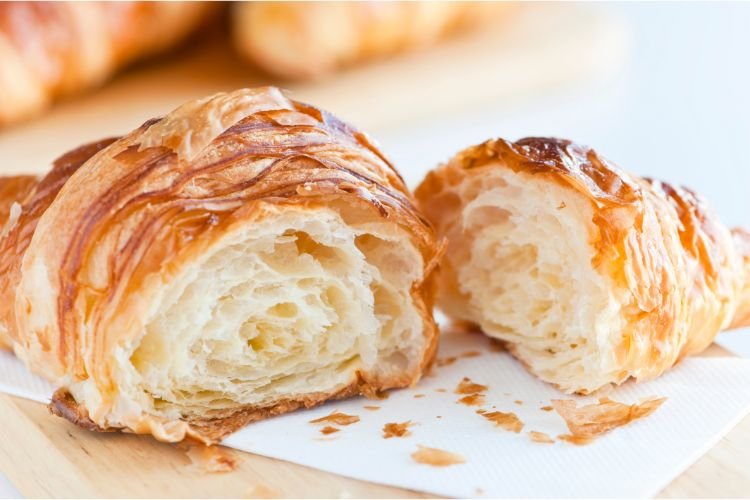
The magic is in the lamination: folding butter into dough again and again to create dozens of thin layers — often more than fifty by the time the dough is finished. Each fold requires resting time, careful temperature control, and precision; too warm and the butter melts, too cold and it shatters through the dough. It’s slow, exacting work, and there’s little room for shortcuts.
When baked, those layers puff and separate, creating a croissant that is crisp on the outside and airy within, its interior webbed with delicate honeycombed pockets. A good croissant should feel light in the hand, flake when torn, and smell unmistakably buttery before you ever take a bite.
Why Croissants Often Disappoint Elsewhere
Many croissants in the U.S. and elsewhere are made with fewer, thicker layers, which creates a softer, breadier texture. Instead of crisp flakes and layered pockets, you get something more uniform — often closer to a soft roll than a pastry.
This is partly intentional. At scale, croissants are often engineered for consistency, shelf life, and durability. Fewer folds, sturdier dough, and sometimes different fats make them easier to transport, freeze, reheat, and hold their shape for hours — or days. The trade-off is texture.
That sturdiness works well for sandwiches and mass production, but it’s very different from the French idea of a croissant. In France, croissants are meant to be fragile and fleeting, baked fresh and eaten quickly. They aren’t designed to travel well, hold fillings, or survive the day — and that’s exactly the point.
Croissant Shapes in France (Yes, It Matters)
Here’s a detail many visitors miss: in France, croissant shape traditionally means something. Only butter croissants are traditionally made straight.
The straight shape developed as a way to signal a croissant au beurre or pur beurre — made entirely with butter.
Curved, crescent-shaped croissants were historically used for croissants ordinaires, often made with other fats like margarine.
Not every modern bakery follows this rule perfectly, but it’s still a well-known convention. If you want to be sure, look for the label au beurre — or just ask.
Other Croissant Variations You’ll Find in France
Once you move past the basic butter croissant, French bakeries offer a small but thoughtful range of variations. These aren’t reinventions so much as quiet adaptations, built on the same laminated dough.
The most beloved of these is the croissant aux amandes. Made from day-old croissants, it’s sliced, soaked lightly in syrup, filled with almond cream, and baked again before being finished with sliced almonds and a dusting of powdered sugar. These are a particular favorite of ours and apparently of other locals, as well, judging by how quickly they tend to sell out in the mornings.
You’ll also find croissants fourrés, filled with chocolate or jam. These tend to be more restrained than their American counterparts, with the filling playing a supporting role rather than taking over. They’re common in neighborhood bakeries and often appeal to children.
More recently, some bakeries offer bicolored croissants, made with cocoa-tinted dough layered into the lamination. These are more decorative than traditional and tend to appear in trend-driven bakeries rather than everyday neighborhood spots.
How the French Actually Eat Croissants
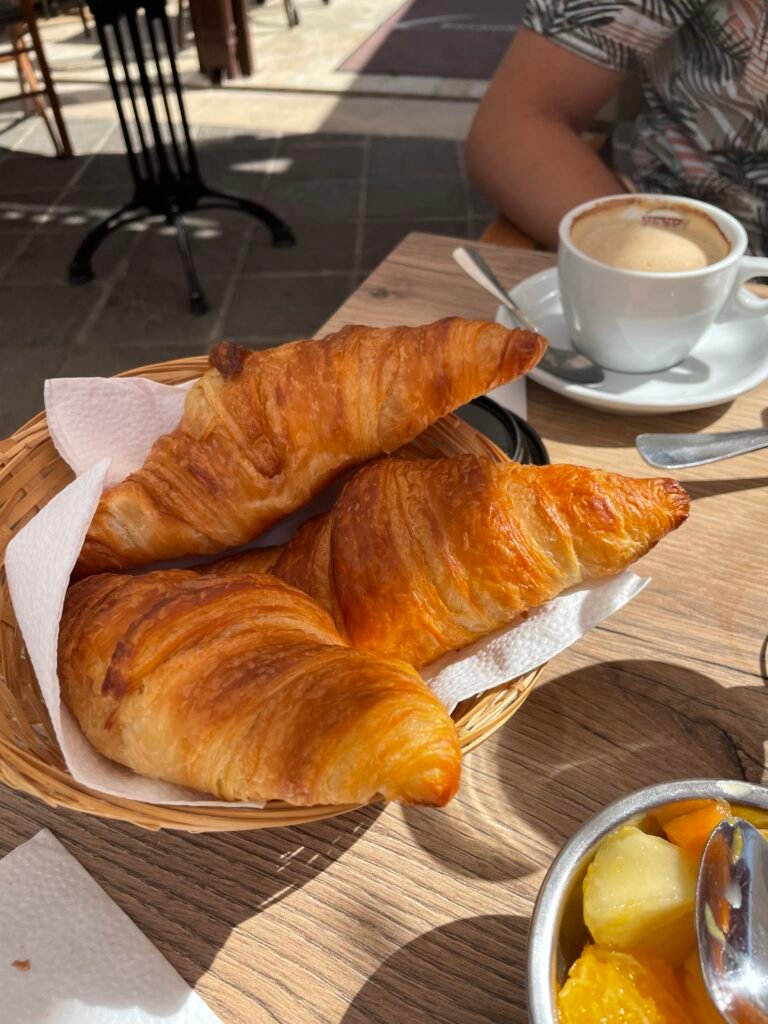
In France, croissants are most often eaten in the morning, usually plain and paired with coffee. They’re torn by hand rather than cut, and sometimes dipped into coffee.
At home or on hotel breakfast tables, a little jam may appear on the side. Croissants can also show up later in the day at le goûter, particularly for children, sometimes alongside hot chocolate. Outside of those moments, they play a limited role.
They’re rarely toasted, rarely dressed up, and rarely linger. A croissant is meant to be eaten fresh.
The Evidence Reveals the Magic
The secret mark of a good croissant reveals itself in the mess. A truly good one flakes immediately, scattering its fine, magical dust wherever it’s eaten. I always know when my husband or sons have stopped at the bakery and eaten one in the car — the black seats tell the story before anyone does.
As for me, I’m fully converted. After years of overlooking croissants when I didn’t know any better, I’ve more than made up for it — now that I’ve been introduced to the real French version.
You can also read more about France’s famous baguettes, another quiet cornerstone of French food culture.