How to Make Dill Pickles in France (Easy Refrigerator Recipe)
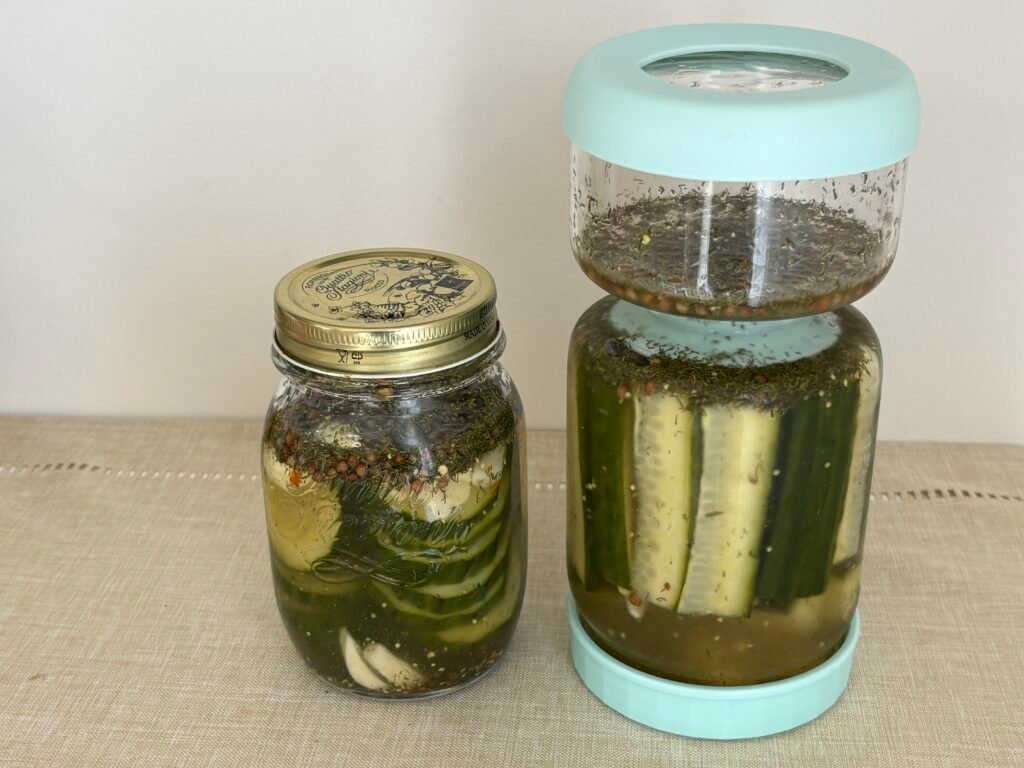
One of the unexpected challenges of moving to a new country is finding equivalents for the everyday foods you never thought twice about. Most of the time, we’ve discovered French substitutes that are just as good—often even better.
Back home, I was used to long sections of the grocery aisle devoted entirely to dill pickles: whole, spears, slices, jumbo dills, baby dills, kosher dills, zesty dills—an entire spectrum of garlicky, briny options.
In France, there was still a respectable pickle section. Jar after jar lined the shelves. But after looking more closely, I realized something surprising: dill didn’t seem to be one of the options.
Why Dill Pickles Are Hard to Find in France
It’s not that France doesn’t have pickles. It’s that pickles play a different culinary role.
In France, pickles are typically designed to complement rich foods like charcuterie, pâté, and raclette. The flavor profile leans sharp and vinegar-forward, often accented with mustard seeds or tarragon.
In the United States, dill pickles are more commonly associated with sandwiches, burgers, and deli foods. The flavor is brine-driven — garlic, fresh dill, and salt — with less emphasis on sharp acidity.
Because the traditional French palate doesn’t center around that garlic-dill profile, large jars of deli-style dill spears simply aren’t part of the standard supermarket offering.
It’s less about availability — and more about culinary tradition.
What Pickles Are Like in France
When you look for pickles in France, you’ll usually find one of three types.
Cornichons
These are the classic French pickles — small, sharply acidic, and firmly vinegar-forward. They’re typically flavored with mustard seeds and sometimes tarragon, which gives them their distinctive bite.
Cornichons are traditionally served with charcuterie, pâté, or raclette. They’re meant to cut through rich, fatty foods. They are delicious — but they are not dill pickles. The flavor is brighter, more acidic, and far less garlicky.
Pickles “Aigre-Doux” (Sweet-Sour Pickles)
These are closer to American bread-and-butter pickles. They’re noticeably sweet, often sliced, and mildly spiced.
If you’re looking for a classic deli-style dill spear to serve with a burger or sandwich, these won’t quite satisfy that craving either.
Malossol-Style Pickles (Sometimes Available)
Occasionally, you might find Eastern European “malossol” pickles in specialty shops. These are garlic-forward, dill-heavy, and more brined than vinegary.
They’re actually much closer to traditional dill pickles — but they’re not widely available in standard French grocery stores.
The Simple Solution: Refrigerator Dill Pickles
After experimenting with a few varieties, I realized I missed that classic garlic-and-dill flavor — so I began making my own refrigerator dill pickles in France.
The good news? They’re incredibly easy. There’s no canning, no special equipment, and no complicated process. You can make them with French cucumbers from your local market and have them ready in a day or two.
Cucumbers in France
Most French supermarkets carry standard salad cucumbers rather than the smaller, thicker-skinned pickling cucumbers common in the U.S. Because of this, your refrigerator pickles may turn out slightly softer. They’re still delicious, but the texture won’t be quite as firm as traditional deli pickles.
Where to Find Dill in France
If you’re wondering how to make dill pickles in France when fresh dill isn’t always obvious, you do have options.
Fresh dill can sometimes be found in larger supermarkets (usually near parsley and coriander), at outdoor markets in season, or in organic grocery stores. It isn’t stocked as consistently as other herbs, but it does appear — especially in spring and summer.
If fresh dill isn’t available, check the freezer section. Many French supermarkets carry frozen herbs in small cubes, including dill. It’s surprisingly convenient and works very well for refrigerator dill pickles.
Dried dill from the spice aisle is another alternative. The flavor is slightly milder than fresh, but still much closer to American-style dill pickles than anything you’ll find pre-made.
And if you have even a small outdoor space, dill is very easy to grow. I added it to my French herb garden, and it’s been one of the simplest herbs to maintain. It grows quickly, requires very little attention, and makes it easy to have fresh dill on hand whenever a pickle craving strikes.
Why Homemade Refrigerator Dill Pickles Became a Staple
Once I discovered how easy refrigerator dill pickles are to make, they quickly became a regular item in our fridge. They’re simple, inexpensive, and easy to customize — from classic garlic-dill to spicier versions with a bit of heat.
They also make a refreshing, low-calorie snack to balance out the baguettes and French cheeses we adore.
And importantly, they don’t replace French pickles — they complement them. Cornichons still have their place alongside charcuterie and pâté, where their sharp acidity shines. But dill pickles fill a different role: layered into sandwiches, served with burgers, or added to salads for that familiar garlic-and-dill flavor.
Having both on hand feels like the best of both kitchens.
Here’s the method we use.
Refrigerator Dill Pickles
Ingredients
- 3/4 cup distilled white vinegar (Vinaigre d’alcool 6%)
- 1.5 tbsp salt
- 1 tbsp sugar
- 3/4-1 cup water
- 2-3 cucumbers (concombres), cut into spears or rounds (about 0.5 kg)
- 3-4 cloves garlic, peeled and sliced in half
- 1 tbsp coriander seeds
- 1/2 tsp mustard seeds (graines de moutarde)
- 1/2 tsp black peppercorns
- 1 pinch red pepper flakes (optional) If you can’t find red pepper flakes, look for “piments secs” in the spice aisle and crush them yourself.
- 6-8 sprigs fresh dill (or 2 tsp dried dill)
Instructions
- In a small saucepan, combine the vinegar, salt, and sugar. Warm over medium heat, stirring just until the salt and sugar dissolve. There’s no need to boil — gentle heating is enough.
- Remove from heat and stir in the cold water. Set the brine aside to cool completely, or refrigerate briefly until chilled.
- Pack the cucumbers snugly into a clean 1-quart jar. Tuck the garlic, coriander seeds, mustard seeds, red pepper flakes, and dill in among the cucumbers.
- Once the brine is cool, pour it over the cucumbers until fully submerged. If needed, add a splash of cold water or vinegar to ensure everything is covered.
- Cover the jar and refrigerate for at least 24 hours before serving. The flavor will deepen after 48 hours.
- Store in the refrigerator for up to one month. Ensure that pickles stay immersed in the brine.
Making dill pickles is just one of the small adaptations I’ve made in our French kitchen. I’ve also written about how I prepare condensed cream of mushroom soup and cottage cheese from scratch when I want those classic staples at home.
Any leftover cucumber ends or herb stems don’t go to waste here — they head straight to our compost. I’ve written more about how we handle composting and recycling in France if you’re curious.